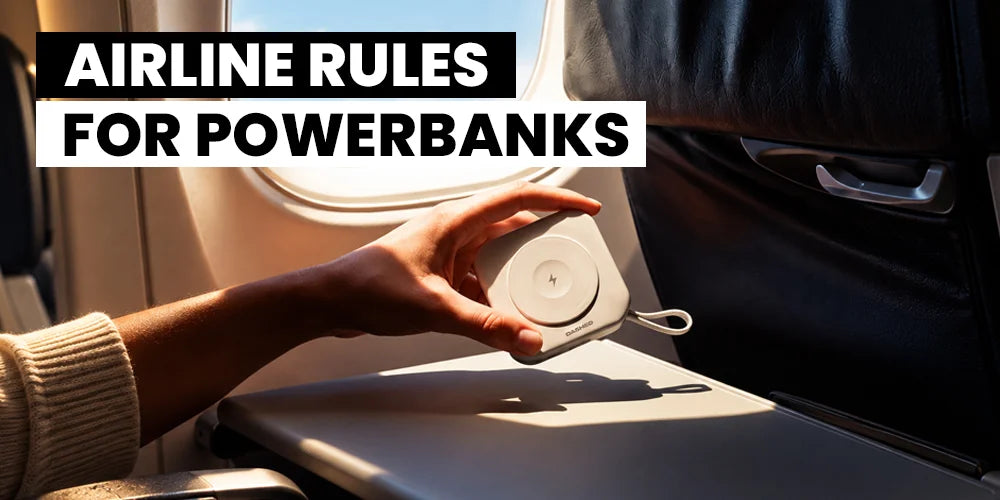
You've probably noticed a string of letters and numbers printed on the side of your power bank, something like "10000mAh (37Wh)." Most people glance right past it. But if you're flying with one, that second number is very important.
Airlines don't care how many milliamp-hours (mAh) your power bank holds. They care about watt-hours (Wh), a measure of total energy, not just charge capacity. Get that number wrong and you could have your power bank confiscated at security, or worse, find out mid-check-in that it's not allowed on the plane at all.
Here's the full breakdown.
The Actual Rules, Explained
Airline power bank rules all tend to use FAA and TSA guidelines, and place devices with lithium-ion batteries into three tiers.
1. Under 100Wh — cleared for takeoff
No special approval needed, no paperwork. This is where the vast majority of consumer power banks, including our Travel Chargers. They just need to travel in your carry-on, never in checked luggage and must remain turned off during the flight.
2. 100Wh–160Wh — you need a green light first
These are the larger "extended capacity" power banks, often used for laptops or camera gear. Airlines allow them, but only with prior approval.
3. Over 160Wh — grounded
Banned outright on passenger aircraft, no exceptions. This tier mostly covers specialty equipment batteries, not standard travel power banks.
A rule that applies no matter the size: spare batteries and power banks must always fly in the cabin with you, never in checked bags. It's also worth covering the terminals, all our Travel Chargers including our best selling TravelPod come included with a Free Packing Case for ease of mind.
A note on China: If you're travelling domestically through China (i.e. flying from Beijing to Shanghai), your power bank will need to have the CCC label printed on the device. International arrivals/departures and transiting should remain unaffected.