

Tokyo has a way of overwhelming people before they’ve even left the airport. It’s a city of neon streets and quiet temples, bullet trains and hidden ramen bars, stacked across dozens of distinct neighborhoods.
The good news is that once you know how to move through it, Tokyo is one of the easiest big cities in the world to explore. This Tokyo travel guide covers the neighborhoods worth your time, a one-day itinerary, the mistakes first-timers make, and the practical stuff most guides skip: plugs, voltage, power banks and staying charged.
Tokyo at a glance
- Best for first-timers4–5 days, one neighborhood at a time
- Getting aroundTrains and a digital Suica card
- Power in JapanType A/B plugs, 100V (50Hz in Tokyo)
- Flying in or outPower banks go in your carry-on
How many days in Tokyo is enough?
One day gives you a taste (see the itinerary below). Three days covers the headline neighborhoods. Four to five days is the sweet spot for a first visit, because you can see a couple of areas a day without rushing. Add more if you want day trips or a slower pace.
Getting to Tokyo and getting around
Airports. Haneda is the closer one, around 30 minutes from central Tokyo on the Keikyu Line. Narita is roughly 60 km out and connected by the Narita Express.
Trains first. Tokyo’s rail network is famously punctual and easy to navigate. It’s almost always faster and cheaper than a car, and you’ll get a feel for the city from the platforms.
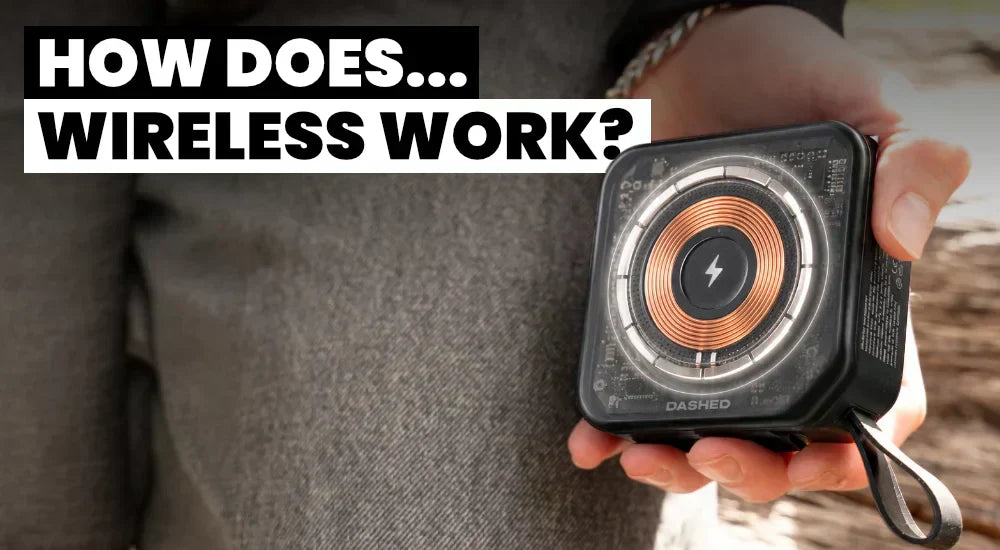
Get a Suica card. Add Suica to your Apple Wallet before you arrive (Android users, check whether your phone supports Suica in Google Wallet). You tap it for trains, convenience stores and even vending machines, so there’s no fumbling for cash or queuing at ticket machines. Our guide to how wireless charging actually works is worth a read if you’re relying on your phone as your wallet.
Taxis. If you do need one, download GO Taxi before you land. It’s notably cheaper than hailing one on the street.
Etiquette basics. Stand on the left on escalators, keep your voice down on trains, and carry your trash with you until you find a bin. Public bins are scarce.
The best Tokyo neighborhoods
Rather than trying to “do” Tokyo in one sweep, pick a starting point and move through the city in layers. Each area has its own personality.
Shibuya is where you go to feel Tokyo’s energy. It’s packed with shopping, big-name stores and that famous never-ending crossing.
Harajuku is Tokyo’s creative outlet. Expect bold fashion, iconic cafés and side streets that reward a slow wander. Pair it with Omotesando for boutique storefronts.
Shinjuku has some of the best food and the heart of Tokyo’s nightlife. By day it’s business towers and department stores. By night it becomes glowing alleyways of yakitori stalls and tiny bars, with Kabukicho’s neon nearby.
Asakusa is the slower, more peaceful side of the city. This is old Tokyo, home to Senso-ji Temple and the Nakamise shopping street, and it feels worlds away from the skyscrapers.
Akihabara is the center of anime, manga, electronics and arcades.
Ginza is the upscale hub for luxury shopping and fine dining.
Shimokitazawa is the one most first-timers miss. It’s filled with vintage shops and boutique cafés, and it’s a short train ride from Shibuya.
One day in Tokyo: a simple, perfect itinerary
If you only have one day to get a true feel for the city, here’s how to spend it.
Morning. Start with coffee near Yoyogi Park, then wander through Harajuku and Omotesando for breakfast and a look at the boutiques.
Midday. Hop on the train to Shimokitazawa for vintage shopping and a long lunch at a local café.
Evening. As the sun starts to drop, head back to Shibuya. Cross the famous Shibuya Crossing, then go up to Shibuya Sky for one of the best night views in the city. Book ahead if you can, especially for sunset. Finish with ramen, sushi or a seat at a local izakaya on your way home.
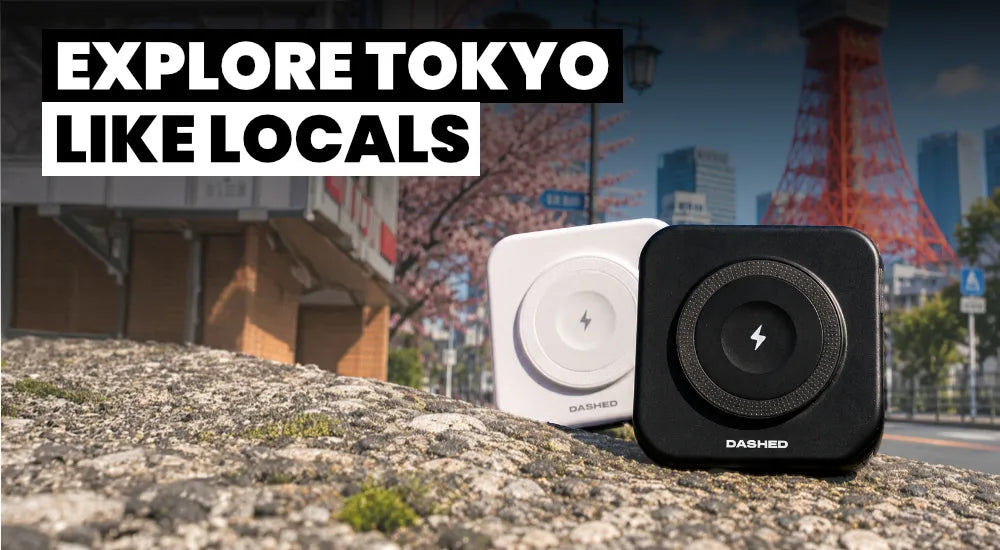
A full day of maps, translation, photos and payments is hard on a phone battery. Pack a portable charger like the Dashed TravelPod before you leave the hotel, so you’re never caught searching for an outlet when you’d rather be exploring.
What most first-timers get wrong
A few small mistakes eat up time and money in Tokyo.
- Defaulting to a car or Uber. Trains are the better default. Save taxis for late nights and awkward luggage.
- Skipping the travel card. Without Suica you’ll queue at ticket machines and fumble for change.
- Relying on cards only. Japan has plenty of contactless payment, but small restaurants, shrines and some izakaya still prefer cash.
- Over-scheduling. Tokyo is huge. Two neighborhoods a day beats five rushed ones.
- Leaving with a low battery. Missing the last train with a dead phone is the worst version of this trip. More on this below.
Do you need a travel adapter in Tokyo?
It depends on where you’re traveling from. Japan uses Type A plugs (two flat parallel pins), with some Type B sockets (two flat pins plus a round ground pin). Voltage is 100V, and Tokyo runs on 50Hz.
| Traveling from | Plug adapter needed? | Notes |
|---|---|---|
| US or Canada Usually no | Usually no | Same Type A plug. A three-prong plug needs a three-to-two prong adapter. |
| UK or Ireland Yes | Yes | Type G plugs don’t fit Japanese outlets. |
| Australia or New Zealand Yes | Yes | Type I plugs don’t fit. |
| Europe Yes | Yes | Check voltage as well (see below). |
Do you need a voltage converter? Almost certainly not. Check the small print on your charger. If it says 100–240V, which covers most phone, tablet and laptop chargers, you only need a plug adapter. Hair dryers and straighteners are the usual exception, so check them before you pack.
An adapter, power bank and wireless charger in one
If you’d rather pack one device than three, the Dashed TravelPod is built for exactly this. It works in Japan and 150+ countries, with four adapters in the box (US, UK, EU and NZ/AU). Its AC input handles 100–240V, so Japan’s 100V is covered.
It also has a 10,000mAh battery, built-in Lightning and USB-C cables, a USB-A port and a wireless pad for iPhones, AirPods and Apple Watches, all in 270g. Recharge it at any wall outlet by clipping on the right adapter.
- Carrying a laptop? Look at the TravelPod Pro instead, as the standard TravelPod isn’t designed for laptops.
- Want extra battery on top? The Dashed Lite is a 3-in-1 power bank, and the Traveller Bundle pairs it with the TravelPod. See all Dashed travel chargers or bundle and save.
Flying to Japan with a power bank: the 2026 rules
This is the part most guides miss. Since April 24, 2026, tougher rules apply to flights to, from and within Japan:
- Carry-on only. Power banks can’t go in checked luggage.
- Max two per passenger, each 160Wh or less. The TravelPod is 37Wh, well under the limit.
- No charging the power bank on board, including from the seat outlet or USB port.
- No using a power bank to charge your devices in flight.
- Keep it accessible, not stowed in the overhead bin.
In practice, charge everything before you board and keep your power bank in your bag. You can still charge your phone directly from the seat’s own power supply if your aircraft has one. Airline policies vary, so check yours before you fly. Japan’s tourism board has the official details.
Make your battery last a full Tokyo day
Tokyo is a full-day phone city. Maps, train routes, translations, photos and payments all add up. A few habits help:
- Download offline maps for the neighborhoods you’re visiting.
- Top up on the move with a power bank instead of hunting for outlets. Pack your TravelPod before you leave the hotel each morning.
- Charge your phone while you sleep, but see whether overnight charging is bad for your phone for how to do it kindly.
Staying connected. An eSIM lets you land with data already working, so you can load maps and book GO Taxi straight away. Browse Dashed eSIMs before you fly.
Frequently asked questions
How many days in Tokyo is enough?
Four to five days suits most first-time visitors. You can see the highlights in three, and a single day is enough for a taste.
Do I need an adapter for Japan?
If you’re coming from the US or Canada, usually not. From the UK, Ireland, Europe, Australia or New Zealand, yes. A travel charger with built-in adapters, like the TravelPod, covers it.
What plug type does Japan use?
Type A, with some Type B sockets. Both have flat pins, and Japan runs on 100V.
Can I bring a power bank to Japan?
Yes, in your carry-on, up to two units of 160Wh or less each. You can’t use or charge them on board.
Is Tokyo easy to get around without speaking Japanese?
Yes. Signs and station announcements include English, and a translation app plus a charged phone covers the rest.
Is Suica worth getting?
Yes. It works on trains, at convenience stores and in vending machines, and you can add it to your phone’s wallet before you arrive.
Planning more of your trip
Heading to Italy next? Read our Rome travel guide, or see the best travel chargers and power banks for phones and tablets before you pack.